

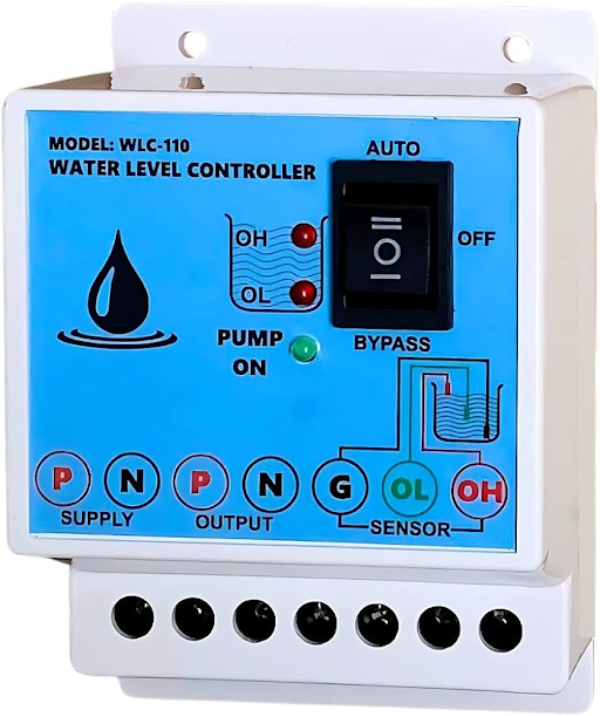
Water pumping becomes inefficient when someone has to repeatedly check tank levels and manually switch equipment on and off. In residential developments, factories, commercial buildings, industrial facilities, and water-storage systems, a Water Level Controller can automate part of this routine.
The basic purpose is straightforward. The controller responds to detected water levels and manages pump operation according to the configured system.
Manual Pump Operation Has Practical Limitations
Manual control depends on someone noticing that a tank needs water and remembering to stop the pump later.
This creates several possible problems.
A pump may run longer than required. A tank may overflow. Water may become unavailable because the pump was not started in time. Staff may also spend unnecessary time repeatedly checking levels.
Automation reduces this dependence on constant human intervention.
Water Level Controllers Use Level Information
A controller works with sensing arrangements that detect the water condition at defined points.
Depending on the system design, the pump can be started when the water reaches a lower threshold and stopped after the required upper level is reached.
This can make water transfer more consistent.
The exact controller configuration depends on factors such as tank arrangement, pump type, electrical system, operating logic, and application.
Automatic Control Can Help Reduce Overflow
Tank overflow is both a water-management and facility-maintenance issue.
Repeated overflowing can waste water and create damp areas around tanks. In some buildings, overflow may affect terraces, shafts, walls, equipment areas, or surrounding surfaces.
Automatic level management helps address the underlying operational cause rather than relying only on overflow pipes to handle excess water.
Pump Protection Still Requires Proper System Design
Automation should not be treated as a substitute for correct electrical and mechanical protection.
A pumping installation may also require:
- Overload protection
- Suitable electrical control panels
- Appropriate cable sizing
- Earthing
- Dry-run protection where applicable
- Correct pump selection
- Reliable sensors
- Periodic inspection
A water level controller is one component within a broader pumping system.
Commercial Buildings Can Benefit From Consistent Operation
Hotels, hospitals, residential societies, offices, factories, educational campuses, and other facilities can have substantial daily water requirements.
When tanks are located at different levels, manual monitoring becomes inconvenient.
Automated level control can help facility teams maintain more consistent storage without assigning personnel to routine pump switching throughout the day.
Industrial Applications May Need Customized Logic
Industrial water management can be more complex than filling a single overhead tank.
Facilities may use underground reservoirs, process tanks, collection pits, transfer pumps, multiple pumps, or standby arrangements.
In such situations, control logic should reflect the operational requirement.
For example, a system may need to alternate between pumps, activate a standby unit, respond to a high-level condition, or trigger an alert.
This is why controller selection should follow an assessment of the entire system rather than treating the device as an isolated accessory.
Regular Checks Remain Important
Automation reduces repetitive manual work but does not eliminate maintenance.
Sensors can become dirty, electrical connections can loosen, and components can deteriorate over time.
Facility teams should periodically confirm that level detection and pump switching are occurring correctly.
In Pune and other urban and industrial areas of Maharashtra, automatic pumping controls are increasingly relevant where reliable water availability and efficient facility operation are priorities.
A properly configured Water Level Controller can reduce manual intervention, help prevent avoidable overflow, and improve consistency in pump operation. The strongest results come when the controller, sensors, pump, electrical panel, and storage arrangement are designed to function as one coordinated system.