

A pump selected from its maximum advertised flow can still fail when pipe friction, elevation, solids, suction conditions, or discharge pressure enter the calculation. By the end, you will have a practical way to define your duty, compare pump types and quotations, test delivered performance, and judge whether a supplier can support the equipment after installation.
Key takeaways
- Give suppliers flow, total head, solids, temperature, and power details.
- Match pump materials, motor type, and controls to site conditions.
- Compare hoses, fuel, transport, standby equipment, and downtime costs.
- Request commissioning records, test results, and documented failure controls.
Start With a Complete Duty Calculation, Not a Product Brochure
A supplier cannot select the right pump from a brochure’s maximum flow. Give them a completed pump duty point: the flow you need, the head the system creates, and the conditions that can damage the pump.
1. State the required flow in litres per minute or cubic metres per hour, total dynamic head in metres, suction and discharge pipe sizes, fluid temperature, maximum solids size, pH, viscosity, and operating hours per day.
2. Calculate total dynamic head by adding static lift, elevation changes, pipe friction loss, hose friction, losses through bends, valves, strainers and filters, and the pressure required at the outlet. Convert outlet pressure into metres of head before adding it.
3. For suction-lift work, ask the supplier to verify that available NPSH exceeds required NPSH at the pump duty point. Maximum suction lift is not an NPSH margin. Warm water, altitude, long or undersized suction hoses, clogged strainers, and high flow reduce that margin and can cause cavitation.
Require a pump curve showing flow against head. Reject a pump that reaches the required head only at an unusably low flow, or reaches its advertised maximum flow only at zero head. Those are different operating conditions.
Check units carefully. RPM measures shaft speed, not flow. A stated 2,850 RPM is not a measurable delivery rate unless the supplier also gives litres per minute or cubic metres per hour at a stated head.
Match Pump Construction and Power Source to the Site
Choose the pump around where it will operate, not around its horsepower rating. A submersible pump fits a flooded pit or tank because the pump sits in the liquid and avoids suction-lift problems. A surface centrifugal pump fits when access, portability, and a suitable suction arrangement are available.
| Pump arrangement | Main advantage | Choose it when |
|---|---|---|
| Submersible pump | Flooded suction | The pump can remain below the liquid level |
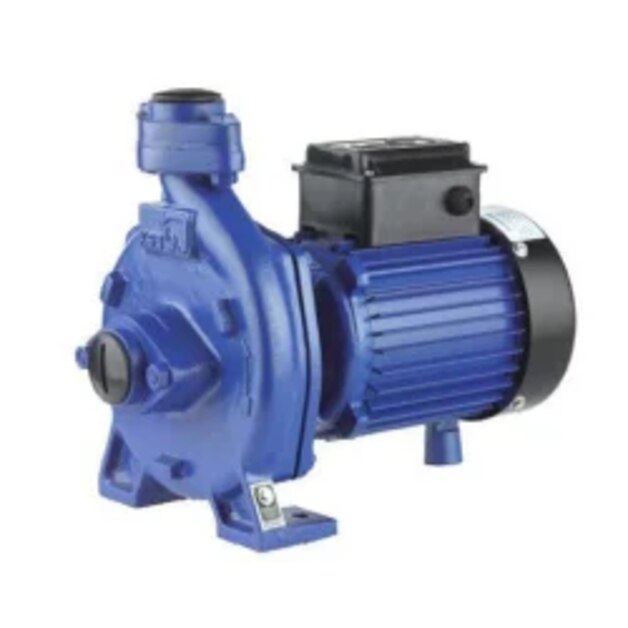
| Centrifugal pump | Simple transfer and portability | A surface setup has reliable suction conditions |
| Self-priming pump | Recovers from air in the suction line | Repeated priming would delay work |
| Booster or multistage pump | Higher discharge pressure | Pressure, not transfer volume, is the main duty |
| Diaphragm pump | Difficult priming and fluid tolerance | Solids or chemically aggressive fluids make other pumps unsuitable |
A slurry or trash pump needs the correct solids-passage size, impeller and wear-plate materials, abrasion resistance, and a written blockage-clearing procedure. A clear-water centrifugal pump can clog or wear rapidly on concrete slurry, silt, or grit.
Single-stage pumps are smaller and easier to maintain. Multistage pumps build higher pressure through several impellers, but add size, complexity, and maintenance points.
Do not approve an electric pump until you verify site voltage, GFCI protection, grounding, overcurrent protection, cable routing, connector suitability, and generator capacity. Compare diesel for remote sites, but require exhaust ventilation and carbon-monoxide controls; a pump outside a basement or tunnel can still send fumes indoors.
Check Solids, Slurry, Hoses, and Dewatering Method Together
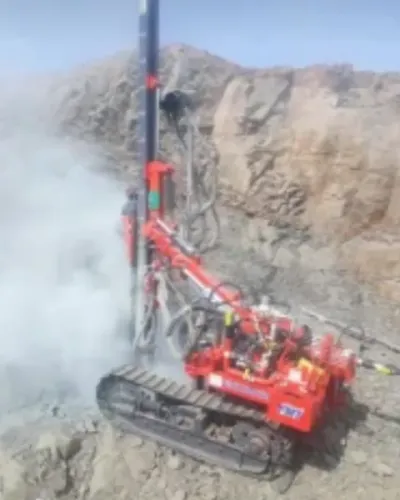
The package controls water only when the pump, solids passage size, hoses, and dewatering system match the ground conditions. Ask whether the duty is open-sump pumping, wellpoint dewatering, deep-well pumping, eductor operation, or staged pumping.
| Method | Suitable condition | Main risk to control |
|---|---|---|
| Open sump | Coarse, stable soils | Fines can cause piping, turbidity, or loss of ground |
| Wellpoints or deep wells | Wider-area drawdown | Inadequate spacing can leave high groundwater |
| Eductors or staged pumping | Difficult drawdown or staged excavation | Poor sequencing can destabilise the excavation |
Require the supplier to state the assumed inflow rate and drawdown-versus-time basis. The calculation must address rainfall, groundwater recharge, river-stage changes, utility leakage, and excavation changes; pump capacity alone does not prove the excavation will remain dry.
Treat concrete-cutting slurry as a waste stream. Specify settling, filtration or vacuum recovery, an abrasion-tolerant slurry pump, wash-water control, and an approved disposal route. Cutting water must reach the nozzles at the required volume and pressure, with slurry capture; pumping slurry away does not establish effective silica control.
Review every hose for discharge-pressure rating, suction or vacuum rating, temperature and chemical compatibility, bend radius, coupling retention, and abrasion resistance. A hose that survives discharge pressure can still collapse under suction.
Ask about sediment, pH, turbidity, and discharge authorization. Dewatering water can require sampling, treatment, and records before release.
Compare Supplier Capability, Rental Terms, and Total Cost
A dependable supplier sells delivered duty coverage, not merely a motor and pump. In a pump rental comparison, test the quoted pump curve at your required flow, total head, fluid condition, and operating hours, then confirm availability when the site actually needs the equipment.
| Compare | Put in writing | Why it matters |
|---|---|---|
| Package | Suction and discharge hose lengths, couplings, strainers, alarms or telemetry, installation, and transport | Missing hose or monitoring equipment delays commissioning |
| Operation | Fuel consumption, refuelling responsibility, operator requirements, and electricity or fuel supply | A low hire rate can become expensive during continuous pumping |
| Failure support | Response time, replacement-pump obligation, standby charges, and treatment of blocked-impeller or dry-run events | A repair bill or unplanned delay can exceed the rental saving |
| Performance | Flow and head at the stated curve conditions, plus acceptance measurements for flow, power, vibration, and leakage | Maximum flow at zero head does not prove usable site performance |
For critical dewatering, design redundancy around the credible failure: mains-power loss, blockage, rising inflow, fuel depletion, hose failure, or a blocked discharge route. Two smaller pumps with independent power, discharge paths, level alarms, and tested changeover can outperform one oversized pump; include a standby pump when one failure threatens the work.
Calculate lifecycle cost using electricity or fuel, operators, transport, installation, refuelling, monitoring, maintenance, downtime, and removal. Ask for repair records, spare-parts access, and field response evidence. For a Pune-area project, assess Sanas Engineering Khedshivapur’s supplier service capability against those documents, not its product range alone.
Related services
Price: Available on Request Minimum Order Quantity: 1 Unit Key Specifications Application: Submersible Pump Flow Rate: 2850 RPM Power Source:... View service → |
Booster Pumps Specifications Particular Details Product Name Booster Pumps Price ₹13,000 per Unit Minimum Order Quantity 1 Unit Product Type Pump Power Source... View service → |
Demand Field Acceptance Evidence and Failure-Prevention Records
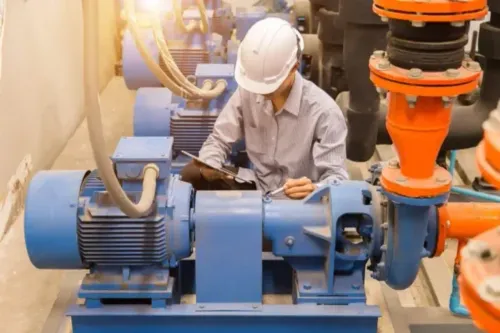
Accept the system at its installed duty point, not from a brochure or factory certificate alone. Agree the pump acceptance test before delivery, including measured flow, total head, input power, vibration, leakage, and tolerances.
ISO 9906 defines acceptance-test grades for rotodynamic pumps, but a factory result at another duty point cannot prove performance through temporary hoses, strainers, fittings, and site elevation changes.
1. Measure commissioning conditions. Record suction and discharge pressures, calibrated flow-meter readings, voltage or fuel consumption, vibration, and water level. Compare these results with the agreed duty point and tolerances; a pump that meets head only after flow collapses has not passed.
2. Require a repair report that identifies the failure mechanism, not merely replaced seals or bearings. Pump repair records should show shaft and bearing condition, measured clearances, electrical test results, vibration findings, impeller wear, and the operating conditions before failure.
3. Demand a cavitation diagnosis when noise, fluctuating flow, pitting, or vibration appears. Check for dry running, misalignment, soft-foot, blocked suction strainers, abrasive solids, incorrect rotation, and repeated starts; each can destroy a repaired pump again.
4. Obtain written operating limits and response instructions. Include inspection intervals, alarm actions, blockage-clearing instructions, and restart procedures. A capable supplier links recurring failures to revised pipework, control settings, filtration, standby arrangements, or operator training instead of returning the same failed pump.
Frequently asked questions
What information should you give a water pump supplier?
Provide the required flow rate, total dynamic head, suction conditions, fluid temperature, solids size and concentration, operating hours, and available power source.
How do you match a pump to an industrial or construction site?
Check pump construction against corrosion and abrasion, then confirm motor voltage, fuel availability, control requirements, access, ventilation, and lifting arrangements.
What should you compare beyond the pump hire rate?
Compare hoses, couplings, transport, installation, fuel or electricity, operator support, standby equipment, repair response, deposits, and downtime exposure.
What evidence should a pump supplier provide before site acceptance?
Ask for a duty-point test, flow and pressure readings, insulation or engine checks, commissioning records, hose and coupling inspection, and documented failure-prevention procedures.
Related services
Water Supply System Hydro Pneumatic Water Supply System Sanas Engineering offers high-quality Hydro Pneumatic Water Supply Systems designed to provide continuous, automatic, and energy-efficient water... View service → |
Dewatering pump Dewatering Submersible Pumps Rental Service We take a huge pleasure in the market by offering best and excellent quality range of Water Pump Rental Services. View service → |
Control Panel Sanas Engineering offers high-performance Electric Water Control Panels designed for efficient operation, monitoring, and protection of water pumping... View service → |
Submersible Pump Repairing Services Submersible Pump Repairing Services 1. Service Type: Submersible Pump Repairing Services 2. Service Mode: Offline 3. Minimum Order Quantity: 1 Unit 4. View service → |